Syntax search for finding explicit subjects of Bara (ברא) and cases where Bara (ברא) with an implied subject

I suspect the syntax databases in Accordance do not get nearly as much use as they deserve. Not because they aren’t useful. But because they can feel hard to enter. That’s understandable. The terminology is specialized, the interface is visual, and even experienced users may not be sure whether they should search for a word, a constituent, a stem, a family, or a semantic category. But once you slow down and work through a real example—like searching for the subject of ברא—you begin to see that the syntax database is not just a technical add-on. It’s a research tool that can answer questions a simple word search cannot.
Okay so let's give it a try for ourselves………………
I had often heard or more than often read the claim that whenever Bara (ברא) the verb with the meaning create appears in Biblical literature its subject is always God. With Accordance's syntaical databases it is now possible for anyone to check this claim out for themselves.
Here in a nutshell is how I would go about doing that. I would run two searches one for explicit suubjects of Bara (ברא) and another for cases where Bara (ברא) is used in the passive.
This is the first major idea to understand that the subject in this case is a constituent, just a word so in the Andersen–Forbes database you need to set up your search like this:
- Predicator is a constituent
- Subject is a constituent
- The lexeme ברא is the word-level restriction you place inside the Predicator constituent
In other words you are searching for:
a Clause that contains
a Predicator whose lexeme is ברא,
and a Subject in the same clause.
Figure 1. A syntax search for the explicit subject of ברא in the Andersen–Forbes database.
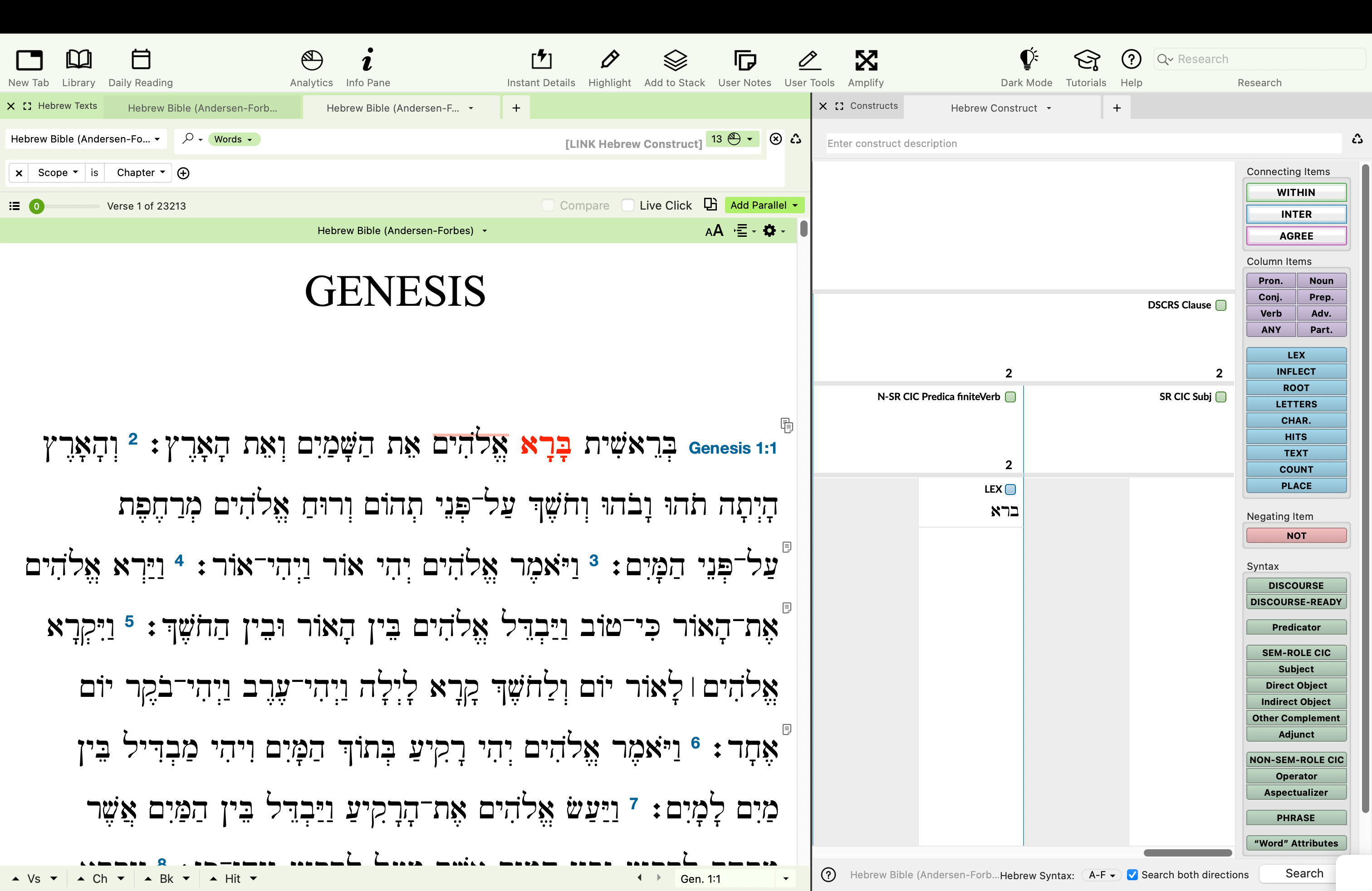
the image above shows a construct with:
- DCSRS Clause
- N-SR CIC Predicator
- LEX = ברא
- SR CIC Subj
- Search both directions checked
A step-by-step guide to building that search
1. Start a new Hebrew Construct search
Open a new Hebrew Construct tab and make sure it is linked to MT-AFD.
2. Add a Clause
Drag DISCOURSE into the workspace and set it to Clause.
This is important. Without the clause wrapper, you may get looser results that do not guarantee the subject and predicator belong to the same clause.
3. Add the Predicator
Inside the clause, drag in Predicator.
In the Andersen–Forbes system, this will appear as something like:
- N-SR CIC Predicator
- or Non-SR CIC Predicator
4. Add the lexeme ברא
Drag LEX into the same column as the Predicator and set it to:
- ברא
This tells Accordance you are looking for clauses where the Predicator contains the lexeme ברא.
5. Add the Subject
In another column inside the same clause, drag Subject.
This will typically appear as:
- SR CIC Subj
That is exactly what you want.
6. Check “Search both directions”
Since Hebrew word order can vary, it is wise to check:
- Search both directions
That allows Accordance to find both:
- verb before subject
- subject before verb
7. Run the search
When everything is in place, click Search.
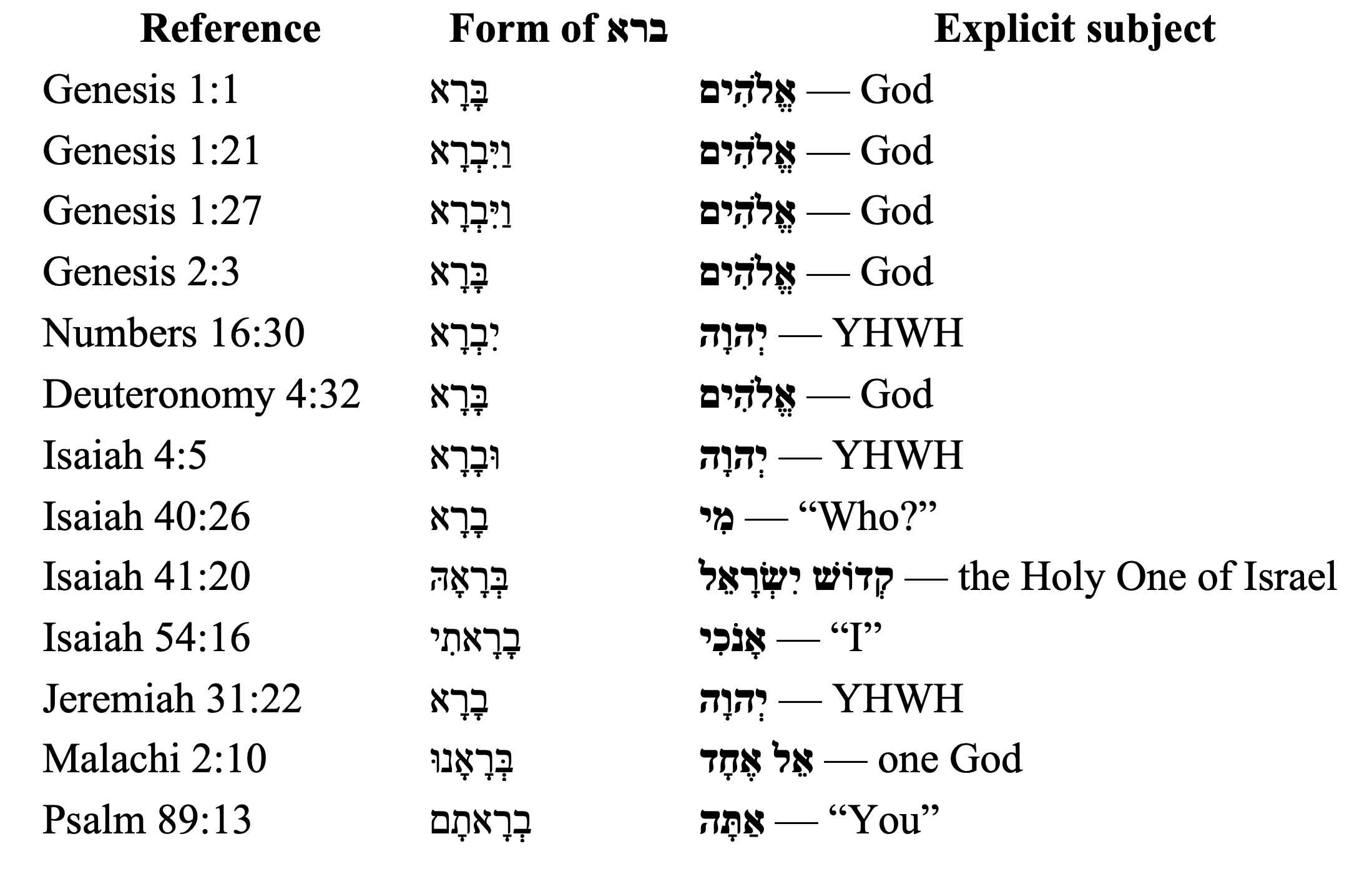
The search Should bring back the following 13 hits:
Part 2: Looking for passive uses of ברא
Now our next question might be:
How do we find verses like Ezekiel 28:15, where ברא is used in a passive sense?
For passive-type uses, the most straightforward approach is to begin with a morphological search. For example in Ezekiel 28:15, the form is:
- הִבָּרְאָךְ
- a Niphal form of ברא
So the natural idea is to search for verb /ברא/Niphal:
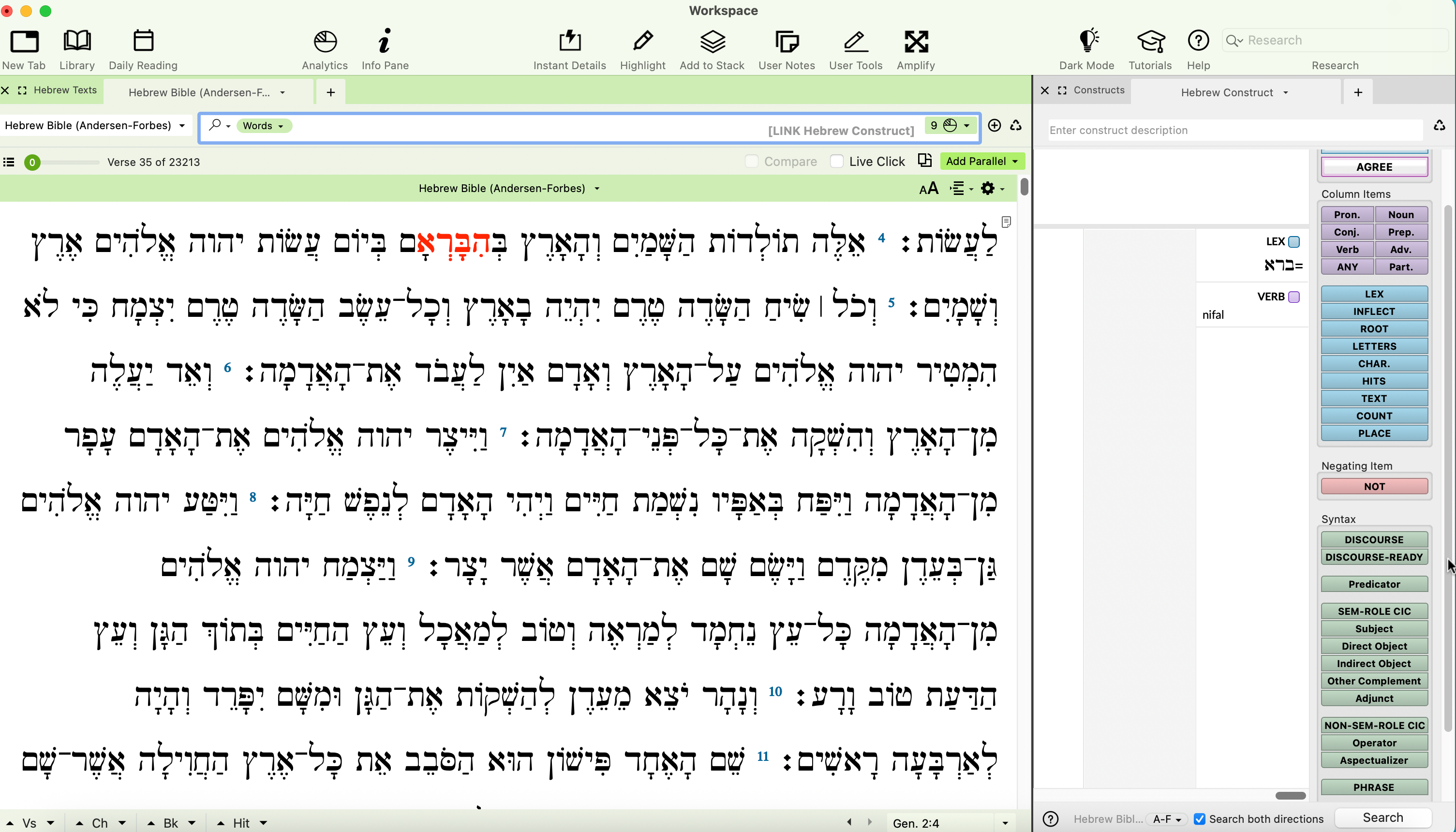
However, this search will return 9 hits and at first, that might seem surprising. Why only 9? Why didn't this search catch Psalm 102:19? Great question! That is because in Andersen–Forbes, the form נִבְרָא in Psalm 102:19 is not classified as a Verb. Instead, it is classified as :
- Noun
- Masculine
- Singular
- Normal
- Human
In other words, even though the form is historically a Niphal participle of ברא, Andersen–Forbes is treating it nominally in that context. So, now we need to drag in a noun tag dialog and in the popup menu find family and select participle .
Figure 2. This search finds cases were bara (ברא) is used in a passive/or passive like way. It does not automatically capture implicit subjects built into verbal forms.
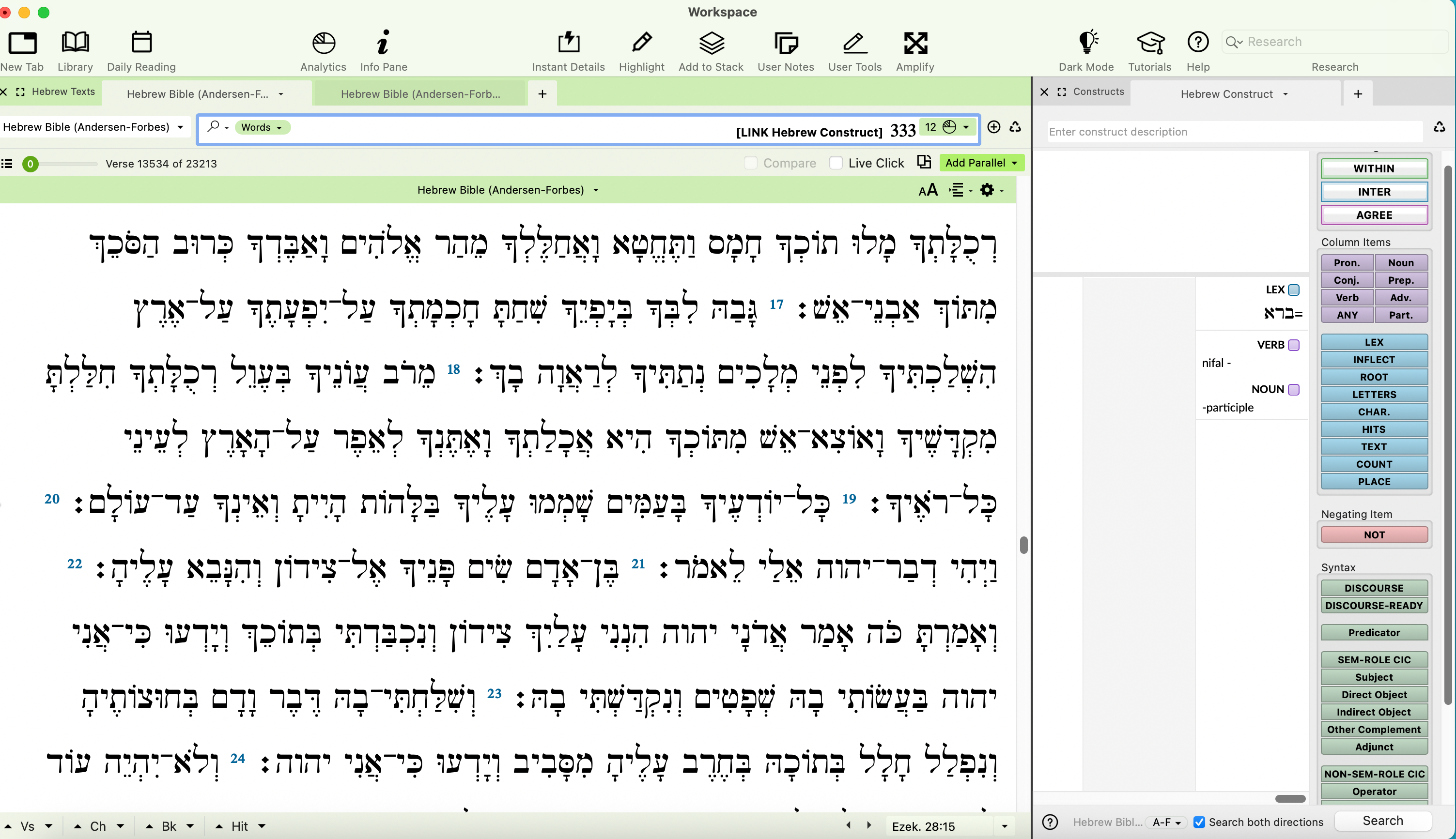
The full passive/Niphal-derived set is:
- Genesis 2:4
- Genesis 5:2
- Exodus 34:10
- Isaiah 43:1 (should be exculuded/weeded out)
- Isaiah 48:7
- Ezekiel 21:35
- Ezekiel 28:13
- Ezekiel 28:15
- Psalm 102:19
- Psalm 104:30
- Psalm 148:5
- Ecclesiastes 12:1 (should be exculuded/weeded out)
However two of hits that appear in this broader search but should be excluded from the passive set because these are active participial uses meaning “Creator”, not passive uses.
I hope that was understandable if not please comment.
Please sign in to leave a comment.
Comments
0 comments